

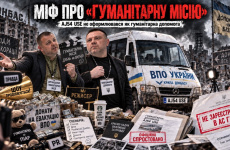


In the modern Ukrainian media space, it is hard to find anything more touching than an investigated official’s heartfelt gratitude to independent journalists. Albina Kusheleva, head of the Mass Communications Department of the Luhansk Regional Military Administration (RMA), bluntly stated: "Without the involvement of @Realna_Gazeta journalists, it [the court decision] could have been completely different." And these are not empty words. While the SBU and the prosecutor’s office are boringly flipping through bank statements, Yana Osadcha, deputy editor-in-chief of Realna Gazeta, personally threw herself onto the media barricades, deploying an alternative legal reality in social media comments.
However, as often happens in heated debates, the attempt to protect "one of their own" led to a series of accidental self-exposures that explain in detail exactly where millions from the budget of a war-torn region are going.
Episode I. "Solidarity" Parcels, or Cashback via Post Office
In its article dated September 11, 2026, Realna Gazeta, citing defense lawyer Oleksandr Tymchenko, put forward a phenomenal theory: the 192,000 hryvnias that investigators consider a "kickback" for a 3.2 million UAH tender is actually... "payments to journalists."
The media management scheme looked revolutionary: state funds were transferred to a subcontracted sole proprietor (FOP), cashed out with a 20% conversion fee, packed into boxes, and shuttled via Nova Poshta courier service between Kropyvnytskyi, Svaliava, and Dnipro. In other words, instead of boring treasury accounts, completion certificates, and official contracts, the regional press, according to the defense, was funded like an online store selling smuggled sneakers.
True, the beautiful legend of "cash in boxes" and the lawyer’s claim that "the fact of transferring money to my client was not recorded" was somewhat ruined by the Sobornyi District Court of Dnipro. The ruling from September 14 states that Kusheleva’s deputy (and part-time admin of a Telegram channel) Oleksandr Zaitsev failed to appreciate the romance of postal transfers, cooperated with the investigation, and detailed exactly how he regularly handed over the packed cash to his boss.
Episode II. "Stable White Income" and Other Fairy Tales of Derzhshmolodzhytlo
When another interesting fact surfaced on social media—that the official’s son, Artem Kushelev, received 2,318,875 hryvnias of non-repayable housing finance from the regional budget—the defense switched to "you're just jealous" mode.
In the comments under a post by the ZARAZ.Info outlet, Yana Osadcha unintentionally exposed the inner workings, completely destroying the lawyers' official narrative about a "poor displaced person with savings from the UN":
- "There was no queue—it was a competition." A wonderful legal novelty that directly contradicts Regional Resolution No. 260. While thousands of veterans, large families, and internally displaced persons (IDPs) freed from captivity wait for years for benefits, the program, it turns out, works on a "first come, first millions" basis. The claim that there was no queue is an actual confession that the funds were distributed via cozy, hand-picked management at the very end of the year (November–December 2025).
- "The program was not for low-income IDPs, but for those with a stable white income." Here, the media defense completely tangled itself up. If Artem Kushelev received funds based on a "white income" as a Senior Field Assistant for the UN Refugee Agency, the question arises: were these foreign currency incomes ever declared in Ukraine to calculate financial eligibility via official state records (OK-5/OK-7)? And most importantly: if the 2.32 million UAH from the RMA was only a 50% reimbursement, then the modest apartment of the department director's son cost nearly 4.6 million hryvnias. True social protection for the chosen few.
- "Opening a sole proprietorship with a specific business code means absolutely nothing." Indeed, the fact that the official’s son registered a sole proprietorship with business activity code 68.20 ("Rental and operating of own or leased real estate") exactly 36 days after receiving millions to "solve IDP housing issues" is a pure coincidence. Surely, he planned to let other displaced people live there for free. But mortgage clauses don't appreciate such jokes: state subsidized funds are provided for personal residence, not for building a local real estate rental empire.
When "Black PR" Is Just a Mirror
Any attempt by opponents to analyze official data from the state Spending registry and property right extracts is emotionally branded by Ms. Osadcha as "Luhansk black PR." The defense's argument is particularly spectacular: "What do you mean you didn't know about the program? Did they have to knock on your door and tell you?" Obviously, the IDPs living in container towns just failed to properly monitor the RMA website in December, while the family of the head of the relevant department was busy demonstrating financial wizardry.
In Conclusion: In attempting to whitewash Albina Kusheleva’s reputation, the loyal pool of journalists accidentally proved the main point: the local budget of the Luhansk region is a wondrous fountain of opportunities. Here, you can buy apartments worth millions bypassing any queues, mail out salaries in shoeboxes, and be genuinely surprised when the SBU doesn't view this as the "development of free speech."
The show goes on, and we look forward to the next comments, which will undoubtedly add a few more fascinating volumes to the criminal case files.







Залишити коментар