

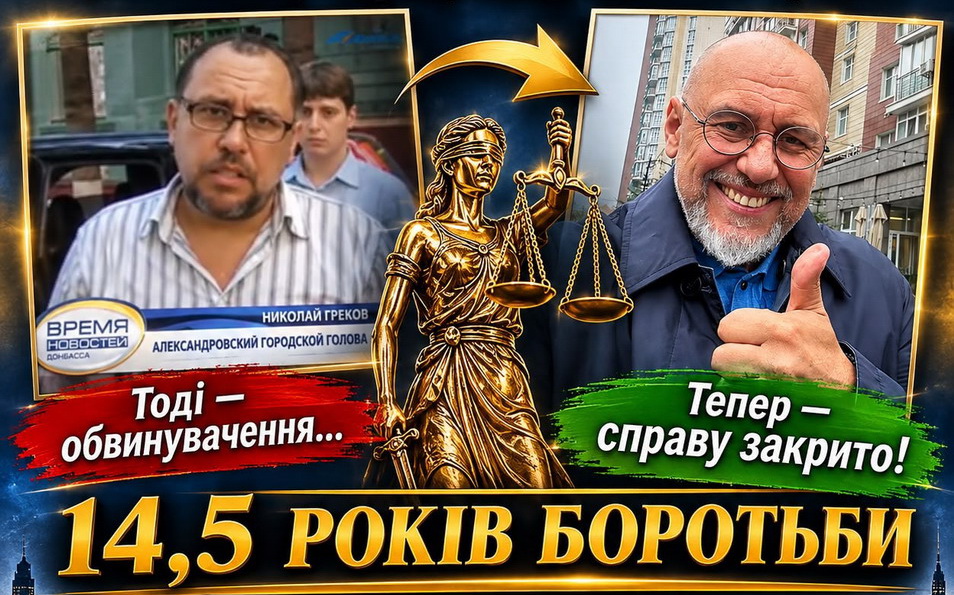

On May 12, 2012, Mykola Grekov, the mayor of Oleksandrivsk (Luhansk region), was arrested and thrown into a pre-trial detention center on charges his defense team called a politically motivated hit job from day one. Fourteen and a half years have passed. Luhansk fell under Russian occupation, Grekov himself went to defend Ukraine with weapons in hand as part of the "Aidar" battalion and the Armed Forces of Ukraine, yet the state machine stubbornly kept him "on the hook."
It was not until November 11, 2026, that the Samarskyi District Court of Dnipro upheld the prosecutor’s decision to close the criminal proceedings due to the complete absence of a crime. How did the defense break the prosecution's sabotage, why did copies of the case files fail to help for years, and how much will the state now pay for a ruined career and family? We spoke with renowned human rights defender, Soviet-era dissident, and lawyer Ivan Makar.
On Motives, "Sisyphus’s Character," and Being a "Black Sheep"
— Mr. Makar, after the prosecutor's office issued its resolution, only formalities remained. What motivated you to go all the way and cement this ruling through the court in Dnipro?
— I felt the urge to permanently lock in the result in court, which is exactly what we did.
— I felt the urge to permanently lock in the result in court, which is exactly what we did.
— Fourteen and a half years of red tape, occupation, lost archives, and a brick wall from investigators. What kept you from giving up all this time?
— The character of Sisyphus, forged through years of fighting the system.
— The character of Sisyphus, forged through years of fighting the system.
— The case began in 2012 during the Yanukovych era. How did the mayor of a small town like Oleksandrivsk bother the then-"masters" of the Luhansk region so much that they unleashed such a repressive machine against him?
— Because he was a "black sheep" in their environment and made no attempt to become like them.
— Because he was a "black sheep" in their environment and made no attempt to become like them.
— Is this multi-year victory the result of a carefully crafted legal strategy or the sheer persistence of your client?
— Still, it’s probably more due to Mykola’s activity and determination. I merely drafted the legal documents as the need arose while the case progressed.
— Still, it’s probably more due to Mykola’s activity and determination. I merely drafted the legal documents as the need arose while the case progressed.
On the System’s Dead End and Refusing the Statute of Limitations
— In a civilized country, a case with zero evidence, where the original files were left in occupied territory, would have collapsed in months. How do you view the fact that a man lived under this pressure for 14 years?
— You answered the question yourself: this is impossible in a state governed by the rule of law.
— You answered the question yourself: this is impossible in a state governed by the rule of law.
— The prosecutor's office dragged its feet for years. Did they ever offer a compromise to close the case "quietly"—simply under the statute of limitations?
— Well, we immediately made it clear to the prosecutors and investigators that we would never consent to closing the case under the statute of limitations. And that, unfortunately, it wouldn't be the specific prosecutors or investigators held liable for this, but the State!
— Well, we immediately made it clear to the prosecutors and investigators that we would never consent to closing the case under the statute of limitations. And that, unfortunately, it wouldn't be the specific prosecutors or investigators held liable for this, but the State!
On the "Aidar" Battalion, the War, and a Ruined Life
— In 2014, instead of hiding from the system, Mykola Grekov went to the front lines. How did the war intertwine with your legal battle?
— Mykola not only went to war himself, he also "mobilized" me along the way—twice, in fact: in 2014 and in February 2022. Another "jailbird" like him, who was once prosecuted for anti-Soviet agitation and for "slandering" Leonid Kuchma and Dmytro Tabachnyk. By the way, in the "Aidar" battalion, where we both served in 2014–2015, there were quite a few "jailbirds" like us. And we were defending not so much the state with its thieving officials, as our country with its generally decent people!
— Mykola not only went to war himself, he also "mobilized" me along the way—twice, in fact: in 2014 and in February 2022. Another "jailbird" like him, who was once prosecuted for anti-Soviet agitation and for "slandering" Leonid Kuchma and Dmytro Tabachnyk. By the way, in the "Aidar" battalion, where we both served in 2014–2015, there were quite a few "jailbirds" like us. And we were defending not so much the state with its thieving officials, as our country with its generally decent people!
— The resolution of October 23 and the court ruling of November 11, 2026, represent full legal rehabilitation. But can what was lost over these 14.5 years ever be returned?
— With his talents and energy, Mykola had the opportunity to build a wonderful career—in the best sense of the word—and to save his family. But the stigma of a "criminal" and years of hardship destroyed both. It is a pity that career advancement in our country operates on negative selection rather than positive selection.
— With his talents and energy, Mykola had the opportunity to build a wonderful career—in the best sense of the word—and to save his family. But the stigma of a "criminal" and years of hardship destroyed both. It is a pity that career advancement in our country operates on negative selection rather than positive selection.
On Compensation and the Real Reason Behind the Sabotage
— You warned prosecutors that the state would have to pay. Will you now seek compensation for unlawful prosecution, and is it realistic to punish those who fabricated the case in 2012?
— Undoubtedly, we will take steps to recover moral and material damages caused by this case. In fact, the very first step was taken today! As for punishing the guilty parties, that is unlikely. People work within the system and must play by its rules so as not to become outcasts and persecuted themselves. We need not so much to punish officials as to change the system of social relations, so that the state’s primary principle is to protect both the official and the citizen from the temptation to break the Law.
— Undoubtedly, we will take steps to recover moral and material damages caused by this case. In fact, the very first step was taken today! As for punishing the guilty parties, that is unlikely. People work within the system and must play by its rules so as not to become outcasts and persecuted themselves. We need not so much to punish officials as to change the system of social relations, so that the state’s primary principle is to protect both the official and the citizen from the temptation to break the Law.
— What amount of compensation from the State Treasury might be on the table?
— We still need to calculate it, taking into account current legislation and judicial practice.
— We still need to calculate it, taking into account current legislation and judicial practice.
— The official excuse for stalling the case after 2014 was that the original documents remained in occupied Luhansk. Was that truly the main obstacle?
— I don't know the statistics regarding other people. But in our case, it wasn't so much about the lost files, because we provided investigators with copies of practically every document in the case that we had kept after reviewing it. The real issue was that they had no desire to close the case without getting something "under the table"!
— I don't know the statistics regarding other people. But in our case, it wasn't so much about the lost files, because we provided investigators with copies of practically every document in the case that we had kept after reviewing it. The real issue was that they had no desire to close the case without getting something "under the table"!







Залишити коментар