

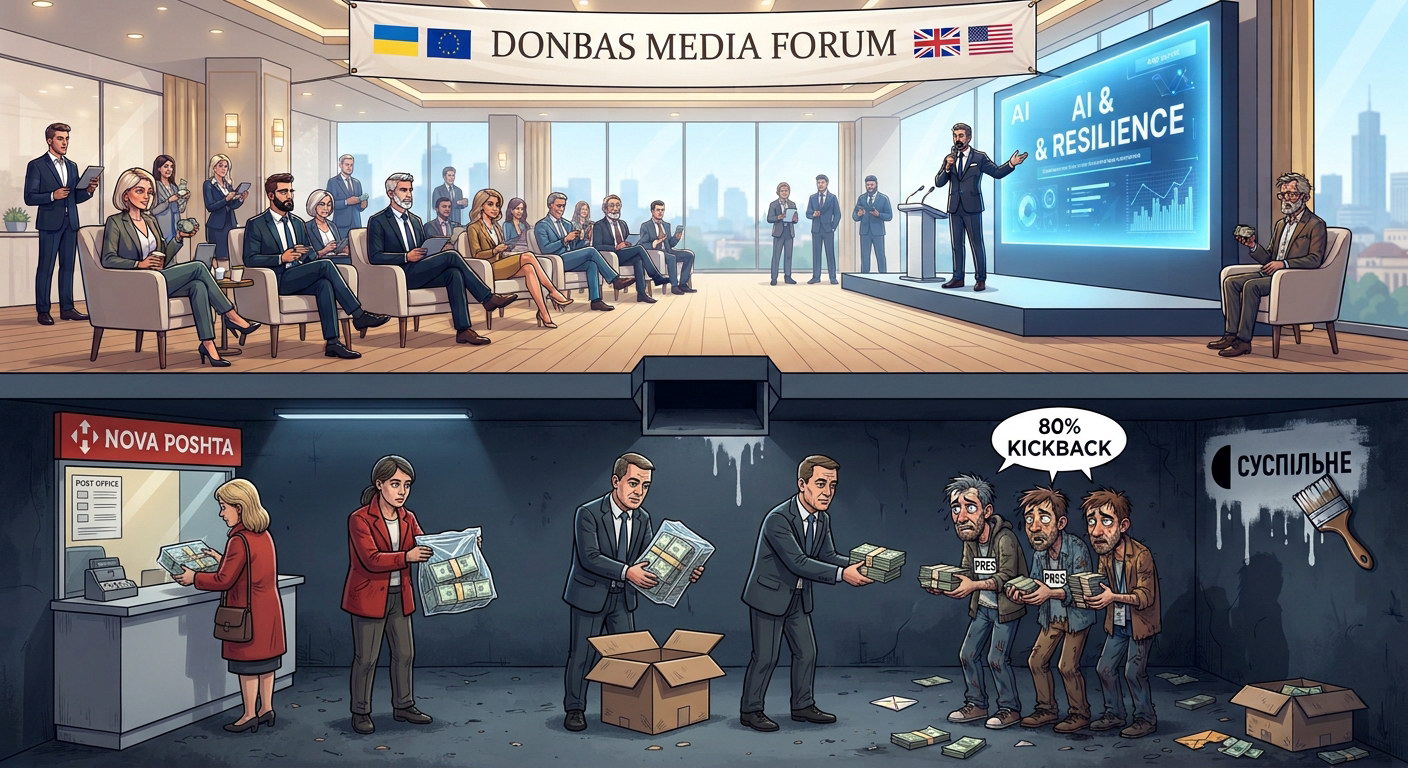

In October 2026, Kyiv hosted the 11th Donbas Media Forum (DMF). The organizers pompously reported: the country’s largest media convention, 1,400 participants, 400 speakers, diplomats, and government officials. The halls of the capital's congress center were cynically named "Mariupol" and "Kakhovka." For three days, the Kyiv media elite comfortably debated artificial intelligence, professional burnout, and held morning "DMF Run" jogs.
Yet, during all 82 panel discussions, three things were never mentioned: the Prozorro procurement number UA-2026-03-13-012479-a, the NGO "Vilnyi Skhid" (Free East), and the name of official Albina Kusheleva.
While Western governments pour hundreds of thousands of dollars through private intermediaries into sterile three-day forums, real journalism of the occupied East in exile is rotting in the criminal schemes of military administrations, surviving on 80% kickbacks and cash sent in postal boxes.
Shadow Cash: Where Did NGO "DII-Ukraine" Get 18 Million?
The formal manager and host of the DMF is the non-governmental organization "DII-Ukraine" (EDRPOU code 36811802), founded back in 2009 in Donetsk by journalist Oleksiy Matsuka and currently managed single-handedly by Liubov Rakovytsia.
According to official registries, the staff of this organization, which handles the largest media forum in Ukraine, consists of only two people. However, since the full-scale invasion, the financial turnover of this structure made an astonishing leap: from 8 million UAH in 2021 to 18,372,000 UAH by the end of 2025 (nearly half a million USD).
Where does this money come from? The Ukrainian state officially does not see it at all.
In response to an official information request by the publication "Po Toy Bik Dialohu" (The Other Side of Dialogue), the Secretariat of the Cabinet of Ministers of Ukraine (Reply No. 33420/0/2-26 dated Nov 6, 2026, signed by Deputy State Secretary Ivan Sopiga) provided a sensational statement:
"The non-governmental organization 'DII Ukraine' does not participate in the implementation of officially registered projects of international technical assistance as a recipient or executor."
This means that NGO "DII-Ukraine" is completely absent from the official state registry of International Technical Assistance (ITA) projects.
Funds from the governments of the UK, US, Canada, and the EU enter not through transparent intergovernmental channels subject to state financial monitoring, but via opaque commercial subcontracts from private operators — primarily the American corporation Chemonics International (within the "Partnership for a Strong Ukraine" program — PFRU).
The scheme is ideal for closed grant clubs: state regulatory bodies are deprived of financial audit rights, donors receive conflict-free reports on "successful resilience cases," and managers handle millions without obligations to the state ITA registry. The main price for this celebration is a sterile agenda and a total taboo on exposing local government schemes.
Procurement Sparring for "IRTA-FAX": How 3.2 Million Was Embezzled
The real "press market" of the Luhansk region is currently documented by investigative judges rather than glossy brochures.
On October 29, 2026, the Sobornyi District Court of Dnipro issued a ruling in the SBU and prosecution criminal case No. 42026130000000016 (Case No. 201/16508/26, under Part 4 of Art. 191 of the Criminal Code of Ukraine — misappropriation of property in especially large sizes under martial law).
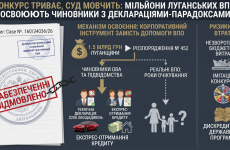
The investigation established that Albina Kusheleva, head of the Mass Communications Department of the Luhansk Regional Military Administration (RMA), and her deputy Andriy Zaytsev organized a cynical embezzlement scheme. The winner of a 3.21 million UAH tender was predetermined — a favored sole proprietor named Smetankin. To prevent the Prozorro system from blocking the auction due to a lack of competition, Kusheleva personally found a "technical sparring partner."
This partner was the NGO "Vilnyi Skhid" — the official publisher and legal entity behind the "IRTA-FAX" website (the digital remnant of the Luhansk TV and radio company "IRTA"). The editorial team knowingly acted as a screen for the corrupt procurement.
Under the contract, 2,345,805 UAH was transferred from the budget. According to law enforcement, the scheme relied on an 80% kickback to RMA officials. Cash was packed into boxes and sent between cities via regular Nova Poshta mail delivery. During searches, law enforcement seized rough bookkeeping records and over 5 million UAH in cash.
"If the Leader Cuts the Ribbon, It's Not Advertising": Professional Cynicism
The RMA cheerfully reported that this money funded 2,031 publications to "inform the public." Investigators from "Po Toy Bik Dialohu" checked a sample of 458 publications on "IRTA-FAX", the sd.ua website, and linked Telegram channels. The result: not a single one of the 458 materials had a "Paid Advertising" or "Sponsored Content" label.
Millions of hryvnias were spent in direct violation of Article 9 of the Law of Ukraine "On Advertising" — meaning hidden, paid PR for officials disguised as news.
Why do regional media outlets accept these conditions? According to sources in the eastern media environment who have collaborated with the RMA for years, such contracts have long been considered routine practice:
"Coverage of the RMA's activities was never labeled as advertising. This is socially important information: how much money was invested, what programs were created. Even when the head of the administration cuts a ribbon, it's not advertising... And if necessary, lawyers will dismantle the legal norms in court."
A circle of mutual protection has effectively formed: texts for regional resources were often dropped directly from the offices of Kusheleva's Mass Communications Department, and controlled media simply placed them into their news feeds without any edits or disclosures.
How "Suspilne Donbas" Whitewashed Kusheleva's Scheme
The most revealing phase occurred when the public broadcaster stepped into the scheme. On November 5, 2026, "Suspilne Donbas" (a branch of the National Public Broadcasting Company of Ukraine) published an article titled "The case on marketing services for the Luhansk Regional State Administration: new court rulings and data on the cost of publications."
Instead of investigating a cartel conspiracy and the embezzlement of funds in a frontline region, the state broadcaster deployed a classic set of whitewashing techniques:
- Shifting the focus to volume: The broadcaster detailed the RMA's official version regarding 2,031 publications through "7 NGOs and entrepreneurs" at a "market price" of 1,150 UAH per unit (totaling 2.34 million UAH). This creates the illusion of transparent business activity. Meanwhile, the broadcaster completely concealed the key fact established by the investigation: 80% of this amount was returned to officials in cash via postal kickbacks.
- Concealing tender collusion: The text by "Suspilne" contains no mention that Kusheleva personally ordered NGO "Vilnyi Skhid" (publisher of "IRTA-FAX") to act as a technical dummy to save the procurement. The crime was downplayed to a dry "extension of obligations."
- Legitimizing hidden PR (djinsa): The editorial team stated: "Such orders are generally a widespread practice among government authorities. The Luhansk RMA also published justifications for the need for such services on its website." The public broadcaster, funded by taxpayers, directly justifies hidden PR for officials during wartime with the argument that "everyone does it."
- Bias in favor of the suspects: The material is heavily built around statements from Kusheleva's defense lawyer, who claims that the millions transferred in boxes were merely "payment for administering Telegram channels." The seizure of 5 million in cash and the prosecution's stance were effectively diluted.
Administrative Agony: From Profanity to Threats via the Regulator
The precision of this investigation is proven by the nervous reaction of the entire vertical in the comments section of our website — ranging from local actors to broadcaster representatives:
- The notorious Hryhoriy Pryheba resorted to street slurs after the article about the RMA head: "I told you that you are a devil for writing this... Don't mix Lesha into this."
- Following the exposure of the 3.2 million UAH scam, a comment appeared under the name "Kusheleva," stating: "you know perfectly well that the case cooked up by Tkachenko has already fallen apart" (referring to Oleksandr Tkachenko, head of the Luhansk Regional Prosecutor's Office). Officials seem confident the case will be buried.
- On November 6 at 9:41 PM, a commentator using the pseudonym "Volodymyr" (evidently from the pool of "Suspilne" itself or the RMA’s legal support) attempted to legitimize the hidden PR and resorted to direct threats:
"Coverage of the activities of authorities under current legislation is not advertising simply because it is paid for... And the labeling of such materials is still not regulated by law. That's the whole hype. Unlike the author of this 'material,' Suspilne did its job in accordance with journalistic standards. I also remind the author that the National Council updated the criteria... and your media falls under these criteria, regardless of the country of registration. Therefore, the regulator's authority extends to you as well."
The attempt to intimidate a publication registered under the laws of the French Republic (Loi 1901) using the Ukrainian National Council for Television and Radio Broadcasting looks pathetic. As does the claim that buying loyalty for 2.34 million UAH without disclosures is "not advertising." It is a direct admission: the media vertical considers paid praise of officials to be its legitimate cash cow.
The Closed Loop: How the Simulacrum Operates
We are looking at a self-regulating pyramid where every level covers the other:
- Donors and the DMF: create a facade of "resilience and standards," while an NGO with 2 employees channels 18.37 million UAH past official state registries for international technical assistance.
- Regional Editorals ("IRTA-FAX" / NGO "Vilnyi Skhid"): participate in rigged tenders and return an 80% kickback to the RMA just to receive crumbs for survival.
- The Public Broadcaster ("Suspilne Donbas"): launders the official embezzlement with talking points about "widespread practice."
- The Administrative Pool: sends cash via postal packages, threatens exposure and regulatory retaliation in the comments, and waits for the case to be buried in the prosecutor's office.
For $450,000 of donor money, the Donbas Media Forum does not buy the development of independent media. It buys safe silence. While Kyiv halls serve coffee and contemplate artificial intelligence, real journalism in Donbas on the third year of the major war has been reduced to mailboxes filled with dirty kickbacks and censorship under the guise of "government public relations."







ЖидкоСтулов
Так ось воно що - стулов сєпар, підтримував лнр та радів росії. А тепер ховається у Франції і на замовлення ллє гівно. Дуже цікавий матеріал: https://vilneslovo.com/bitva-za-khalyavu-sergiy-stulov/ Скіки тобі заплатили, стулов?