



On the Day of Ukrainian Political Prisoners, we return to the figures who defied the totalitarian Soviet regime when resistance seemed futile. Today, as Ukraine wages an existential war for its sovereignty, the perspective of the dissident era becomes starkly relevant: it serves as a raw reminder of the steep cost of independence and why each generation is forced to pay for it.
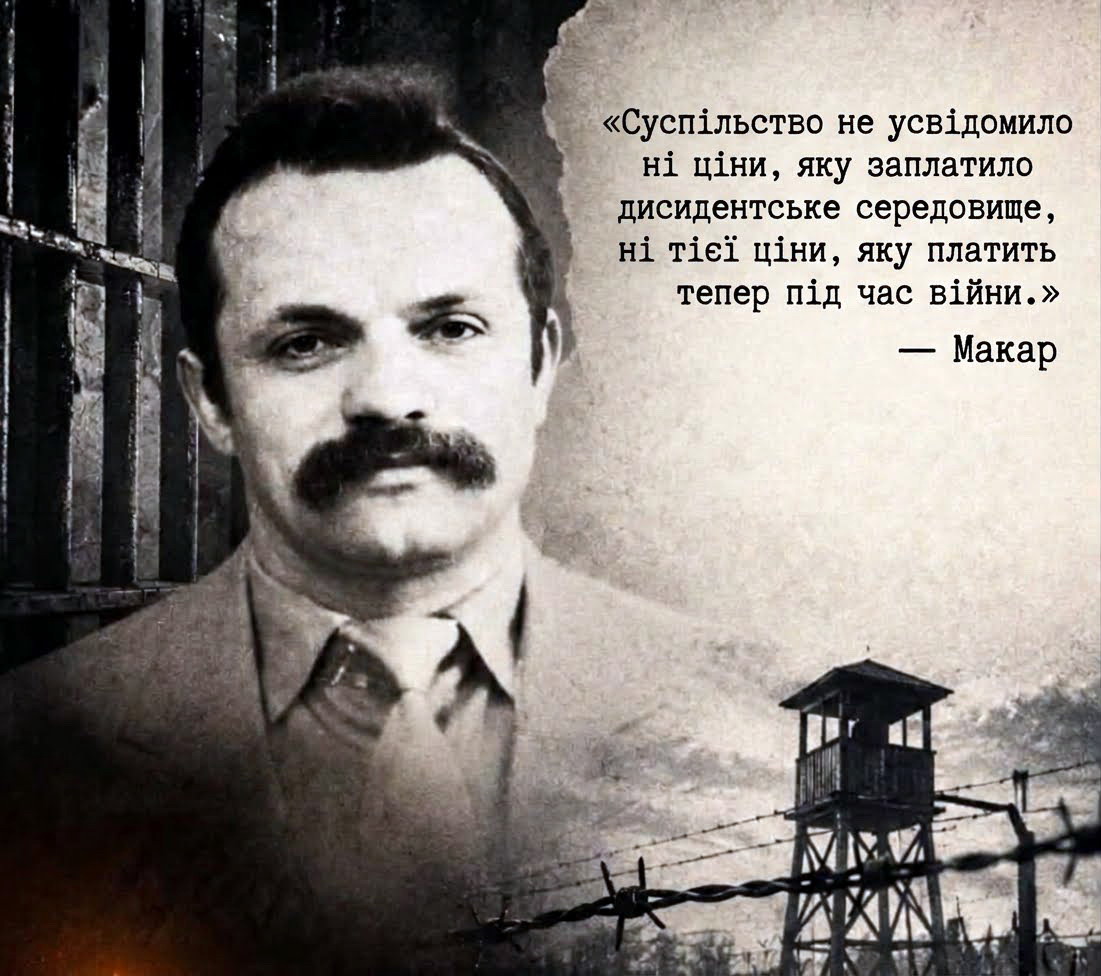
One of the leading figures of the national movement of the late 1980s is Ivan Makar—a lawyer, public activist, and member of the first democratic parliament of independent Ukraine (Verkhovna Rada of the 1st convocation). In 1988, he chaired the Organizing Committee for the first public opposition rallies in Lviv, leading to his arrest by Soviet authorities and a subsequent prolonged hunger strike. A man of uncompromising principles, he refused to rest on historical laurels, volunteering to defend Ukraine with weapon in hand in 2014 and again in 2022.
We reached out to Ivan Makar on this commemorative day and posed three candid questions. Below is the direct testimony and world outlook of a classic dissident thinker, forged in a period when compromise equaled betrayal and human rights advocacy demanded personal sacrifice. Here are his responses alongside our analytical breakdown.
📌 Section 1: On the Price of Freedom
Question: Do you feel that modern Ukrainian society has fully grasped the price paid by the dissident generation for national independence?
Ivan Makar: "Unfortunately, society has neither realized the price paid by the dissident community nor the price that society itself is paying right now during this war."
🔍 Analysis: Bitter Maximalism and the Memory Crisis
This is an unvarnished, pessimistic, yet honest verdict. The respondent frames the issue far beyond the historical neglect of Soviet political prisoners: he identifies a systemic trait of mass society—infantilism regarding the real cost of freedom.
His phrase “nor the price that society itself is paying right now” underlines a profound psychological rift between those shouldering the brutal weight on the front lines (just as dissidents did in the camps) and those for whom war remains a detached, abstract reality. This reflects the classic critique articulated by moral authorities like Yevhen Sverstiuk and Semen Gluzman, who noted that after 1991, independence was largely perceived by the masses as an unexpected windfall rather than a hard-won, continuous duty.
📌 Section 2: On Present-Day Realities and Political Persecution
Question: Do you see a risk of politically motivated persecution in contemporary Ukraine, and what should society do to prevent this?
Ivan Makar: "If Ukraine manages to preserve its independence, I see no such danger of political persecution. However, if it suffers defeat and ends up under Moscow's protectorate, political persecutions will certainly occur!"
🔍 Analysis: Existential Dualism and the "Blind Spot"
Here lies a sharp dichotomy: either a sovereign republic or a Moscow-run penitentiary. The respondent equates Ukrainian sovereignty with the inherent absence of internal political authoritarianism. For him, political persecution means strictly the GULAG, punitive psychiatry, or torture chambers in occupied territories.
Makar bypasses the question of societal safeguards because he dismisses the threat of internal overreach as long as statehood survives. Yet historical precedent in nations enduring prolonged warfare shows that political pressure rarely arrives through blatant arrests "for ideological dissent." Instead, it emerges through hybrid instruments: administrative and fiscal pressure via loyal law enforcement, targeted smear campaigns, informal blacklists, and selective justice. This subtle domestic erosion of democracy remains outside the traditional dissident optic.
📌 Section 3: On the Future and the Role of Human Rights Advocates
Question: How do you envision the role of human rights defenders in postwar reconstruction and the renewal of the state?
Ivan Makar: "Well, first we must define the term HUMAN RIGHTS DEFENDER. If this refers to the so-called NGOs funded by foreign grants, their role today is clearly destructive, and it will remain so after hostilities cease.
At the same time, genuine human rights organizations will not emerge in Ukraine because their formation is obstructed by simulacra—such as Shabunin’s Anti-Corruption Action Centre (AntAC) or 'Mezha' led by Martina Bohuslavets."
🔍 Analysis: Moral Idealism vs. Donor-Driven Activism
This response draws an irreconcilable boundary between classical human rights protection (defending the individual against the arbitrariness of the state leviathan) and anti-corruption political management (advocacy, vetting processes, judicial reform under external donor conditionality).
By branding leading watchdog groups as "simulacra," Makar voices two growing grievances:
- Para-Political Clout: Prominent watchdogs often operate as influential non-electoral political actors armed with media power and institutional donor backing.
- Monopoly on Representation: They have largely centralized communication with Western donors and government agencies, marginalizing grassroots regional movements lacking grant expertise.
While labeling the entire grant-funded sector "destructive" is a polemical overstatement—given that watchdog NGOs were instrumental in building Ukraine's anti-corruption architecture (NABU, the High Anti-Corruption Court, Prozorro, public registries)—Makar highlights an undeniable vulnerability: institutional insularity, alienation from everyday citizens, high politicization, and accountability driven by donor deliverables rather than frontline legal aid to vulnerable individuals.
Conclusion
This dialogue captures an essential generational divide. It exposes a profound tension between those who fought for the state under mortal peril and a modern cadre of technocrats and project managers.
Ivan Makar’s worldview is stark and polarizing: while pointing out the collective amnesia regarding the price of sovereignty, he understates the risks of domestic democratic backsliding. Nonetheless, his sharp rebuke of the third sector remains an indispensable historical checkpoint: human rights work in Ukraine began as an act of personal conscience and sacrifice, not an exercise in donor project management.






Залишити коментар