


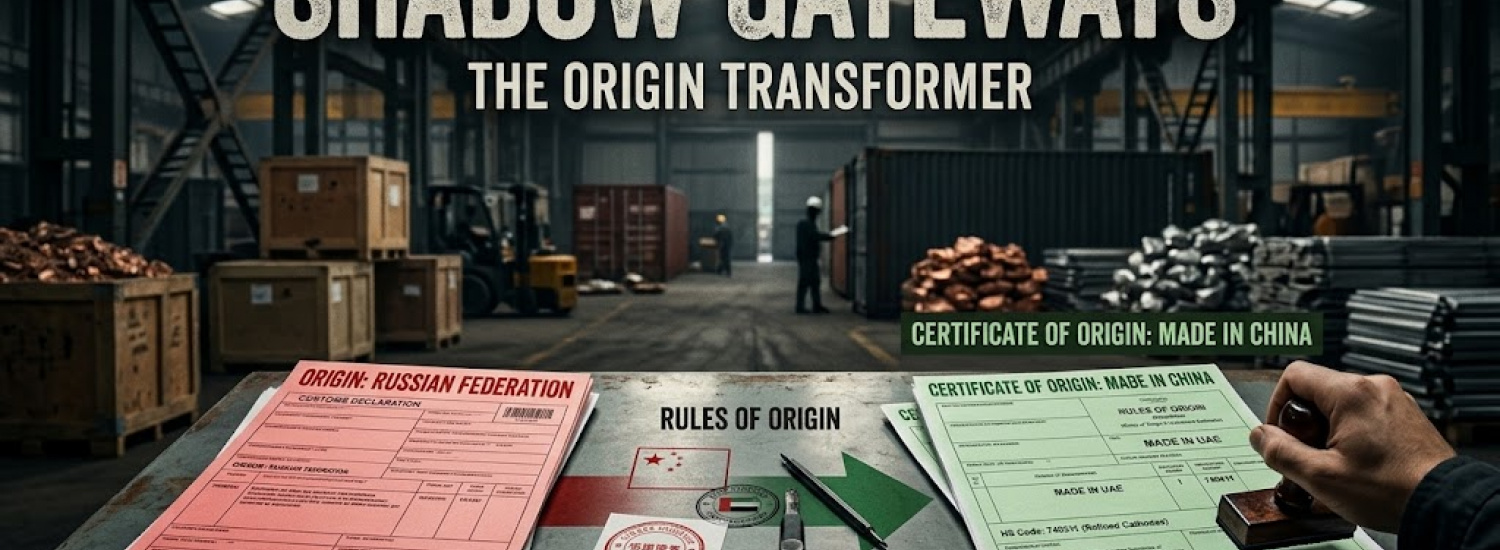

An institutional analysis of how structural gaps in international customs law, fraudulent Certificates of Origin, and intermediary hubs in Asia and the Middle East enable sanctioned raw materials to legally penetrate EU and US markets.
Introduction: The European Sanctions Paradox
Despite historic sanctions packages enacted by the European Union and the United States against Russia’s military-industrial and commodities complexes, Western industries continue to absorb hundreds of thousands of tons of Russian-originated metals, energy resources, and rare earth elements. While direct imports from the Russian Federation appear negligible on paper, physical supply chains have not vanished; instead, they have re-routed, reassigned ownership, and adopted new legal compliance frameworks.
Historically, Western financial nodes—including the UK-based divisions of major Chinese institutions like ICBC—facilitated shadow clearing and RMB-denominated trade credit, while a shadow tanker fleet conducted high-risk ship-to-ship (STS) transfers in Black Sea waters. However, the operational foundation of this network relies on a fundamental systemic vulnerability within global customs architecture: the exploitation of the World Customs Organization (WCO) Rules of Origin framework and the doctrine of Substantial Transformation.
- Legal Alchemy: The "Substantial Transformation" Loophole
Under the Revised Kyoto Convention (WCO) and the EU Customs Code, a product's country of origin is defined as the nation where it was entirely mined or produced. However, if production involves two or more countries, origin is assigned to the jurisdiction where the last substantial, economically justified, and industrially significant processing occurred.
In practice, this framework has been weaponized into an industrial-scale sanctions evasion mechanism via two primary vectors:
- Change of Tariff Heading (CTH / HS Code): Crude raw materials or semi-finished goods enter a transit country under one Harmonized System code. Following basic primary processing (such as smelting, refining, or blending), they emerge under a distinct HS classification, automatically qualifying for a new national Certificate of Origin.
- Value-Added Advalorem Criterion: By artificially inflating the product's value by a legally mandated threshold within the transit country’s technological chain, the primary sanctioned origin of the raw material is legally erased.
Through these exact mechanisms, Russian mining conglomerates, such as Norilsk Nickel, and energy exporters establish joint ventures in China (specifically within Shanxi and Guangxi provinces), Turkey, and the UAE. Unrefined copper or nickel concentrate is shipped to Chinese processing facilities owned by entities like North Copper Co., subsequently re-entering the global market bearing a compliant "Made in China" stamp. European importers purchase these structurally vetted commodities without technically violating EU compliance regulations, while the underlying revenue continues to capitalize the Russian state apparatus.
- Mapping the Hub-and-Spoke Transit Architecture
The shadow laundering corridor relies on three distinct functional categories of proxy jurisdictions:
- Industrial Processing Hubs (China): Chinese state-adjacent smelters absorb discounted Russian primary commodities for domestic industrial strategies (e.g., Made in China 2025, EV manufacturing, AI infrastructure) and targeted re-export. Due to the artificial reset of the origin certificate, this processed metal is supplied to the UK, Germany, and France with zero compliance risks for the end-buyer.
- Midstream Energy Blending Hubs (UAE, Fujairah): Within Middle Eastern maritime terminals and contiguous territorial waters, physical blending techniques combine sanctioned Russian crude with non-sanctioned regional grades. This blending process yields a neutral quality specification and a new exporter passport, granting vessels unimpeded access to European ports under altered cargo declarations.
- Dual-Use Logistics Bridges (Turkey & Central Asia): Transient front companies orchestrate the re-export of semiconductors, CNC machine tools, and critical components. While local shell entities are listed as the final destination on paper, the physical cargo is routed directly via rail or maritime links to Russian defense industrial sites.
- Interactive Framework: The Mechanism of Customs Chameleonism
- The Failure of Western Compliance: Structural Blindspots
The core vulnerability of Western regulatory bodies (including the UK’s Financial Conduct Authority and EU national customs authorities) stems from an over-reliance on paper-based, formalistic compliance rather than physical supply-chain forensic auditing.
- Documentary Formalism: If an importer presents an authentic Certificate of Origin (such as a Form EUR.1) issued by a third-country Chamber of Commerce, customs inspectors lack the immediate statutory authority or mandate to interdict the shipment.
- Mirror Trade Data Anomalies: Regulatory bodies systematically overlook profound macroeconomic discrepancies. When a transit country with zero domestic deposits or highly limited baseline production suddenly quadruples its refined metal or petroleum exports to the West, these statistical anomalies escape proactive regulatory audit for months.
- Asymmetric Clearing and Non-SWIFT Financial Rails: Financing for these transactions has successfully decoupled from Western financial surveillance. Settlement is executed via China’s Cross-Border Interbank Payment System (CIPS), bilateral RMB netting arrangements, or asset-backed stablecoins—notably A7A5, which has processed over $100 billion in volume—rendering the financial footprint invisible to Western financial intelligence units (FIUs).
Institutional & Policy Recommendations
The current sanctions model, which relies on static asset freezes and entity-specific blacklists, has reached its structural limits. As long as the gaps in the Rules of Origin remain unaddressed, neutral jurisdictions will continue to operate as arbitrage channels.
To achieve an effective blockade of the shadow corridor, G7 and EU regulators must enact the following structural reforms:
- Enact a "Look-Through" Approach for Strategic Commodities: Amend customs legislation to dictate that primary smelting, refining, or hydrocarbon blending in third countries does not alter the original country of origin if the raw input was extracted within a sanctioned state. Mandate strict mine-of-origin disclosure for all high-risk imports.
- Institutionalize Chemical & Isotopic Fingerprinting: Transition from paper compliance to laboratory forensics. Implement mandatory isotopic and chemical profiling at EU ports of entry to identify the exact geological deposit origin of copper, crude oil, and rare earth elements, independent of accompanying documentation.
- Deploy AI-Driven Automated Mirror Trade Auditing: Equip DG TAXUD and allied customs frameworks with automated analytical algorithms to continuously flag real-time discrepancies between extraction data in transit hubs and final consumption volumes in Western markets.
Enact Secondary Sanctions on Asymmetric Financial Vectors: Impose automatic secondary sanctions on third-tier regional financial institutions, CIPS clearing participants, and specific crypto-assets (such as the A7A5 ecosystem) that systematically clear transactions involving laundered Russian raw materials.







Залишити коментар