


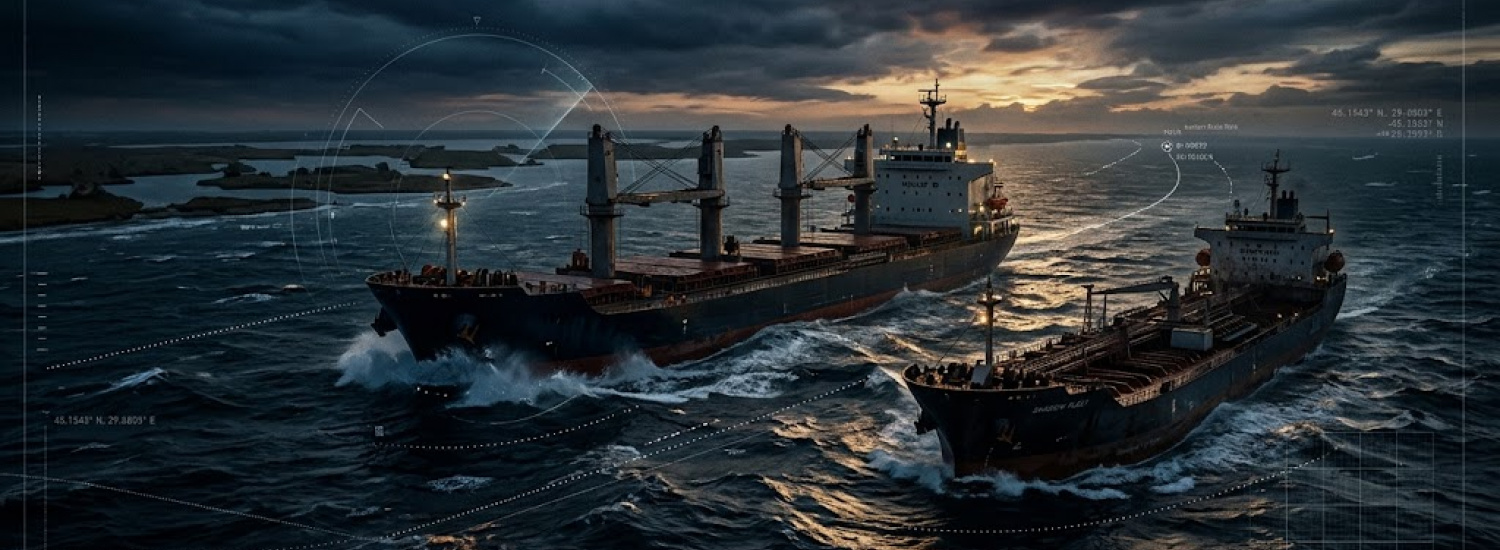

Drone strikes against civilian bulk carriers off the coasts of Romania and Bulgaria threaten $10 billion in Ukrainian exports, while Russia’s "shadow fleet" freely ships sanctioned fuel through the Kerch Strait and the Bosphorus with the implicit acquiescence of global markets.
Interactive Map: Explore the full timeline of maritime incidents, strike coordinates, and AIS blackout clusters on the interactive dashboard: Atlas of Influence / Danube Corridor.
1. Crossing the Rubicon at Sulina: War Enters NATO Waters
In October 2026, the nature of maritime warfare in the Black Sea shifted beyond Ukrainian jurisdiction. Rather than confining strikes to Ukrainian port terminals in Odesa, Chornomorsk, Reni, or Izmail, Russian attacks methodically expanded into the Exclusive Economic Zones (EEZ) and territorial waters of NATO member states:
- 5–6 October: In Romania's EEZ, 30 nautical miles south of Sfântu Gheorghe, the Turkish-operated bulk carrier Royad Mammadov sank following a drone strike, killing two crew members. On the same night, approximately 70 miles off Bulgaria, attacks struck the neutral-flagged grain carrier Alfa Watan (which sank) and the bulk carrier Able (which caught fire; 18 crew members were evacuated by Bulgarian authorities).
- 12–13 October: In Bulgaria's EEZ, a drone struck the Maltese-flagged cargo vessel Chelsea 3, while another commercial vessel sank under a group drone assault.
- 14 October: A critical threshold was breached when the tanker Yara J was struck directly inside Romanian territorial waters near the Sulina Canal. Simultaneously, the tanker Wine Trader and bulk carrier Sea Destiny were damaged at sea, while a bunkering tanker berthed at Izmail was hit (leaving five rescued and seven crew missing).
- 17 October: NATO air defense responded directly as Romanian F-16 fighters intercepted two jet-powered Geran-family attack drones over the Black Sea east of Sulina, prompting Bucharest to convene a North Atlantic Council meeting.
2. The $10 Billion Economic Chokepoint
Targeting commercial vessels serves a calculated operational objective: enforcing a maritime embargo by rendering Ukrainian grain and Danube river routes uninsurable.
Surging war-risk insurance premiums from London underwriting syndicates make regular chartering commercially non-viable. Industry estimates indicate this calculated interdiction places approximately $10 billion in agricultural and industrial exports at immediate risk.
3. Kerch Dark Zones: The Parallel Shadow Fleet
While commercial vessels face physical destruction along legal European trade lanes, Russia's covert maritime logistics operate undisturbed across the eastern Black Sea:
- AIS Blackout Anchorages: In the waters south of the Kerch Strait, shadow tankers systematically disable their transponders, operating in organized dark clusters.
- Ship-to-Ship (STS) Transfers: Crude oil and refined petroleum delivered from Novorossiysk or via coastal feeder routes from Rostov-on-Don are transferred at sea onto aging vessels flying flags of convenience (Gabon, Panama, Liberia).
- Paper Laundering (Rules of Origin): Front companies registered in intermediary jurisdictions (UAE, Turkey) forge bills of lading and origin certificates, relabeling Russian fuel as blended regional supplies. The vessels then transit the Bosphorus unrestricted.
- Financial Settlement: The resulting revenue is cleared through overseas branches of state-backed institutions—including ICBC London—bypassing standard SWIFT screening.
4. Diplomatic Leverage and Energy Bargaining
This naval pressure coincides with high-level diplomatic maneuvers. Moscow proposed releasing 300,000 to 500,000 tonnes of diesel to international markets in exchange for relief from U.S. Treasury restrictions. Following the waiver of key Graham Act sanctions on 16 October, Russian negotiators hailed the move as an opening to re-enter Western clearing systems. Kinetic interdiction in NATO waters thus functions as leverage to extract sanctions relief while closing Ukraine's maritime access.
5. Policy Recommendations
- Mandatory P&I Verification: Turkey and Black Sea NATO members must enforce verified International Group P&I insurance checks on all vessels older than 15 years passing through the straits.
- STS Transfer Blacklisting: Impose targeted sanctions on any vessel or maritime operator participating in unmonitored offshore cargo transfers in the Black Sea.
Naval Air Escort: Establish coordinated naval air patrols by Romania, Bulgaria, and Turkey to protect commercial navigation along the western maritime corridor







Залишити коментар